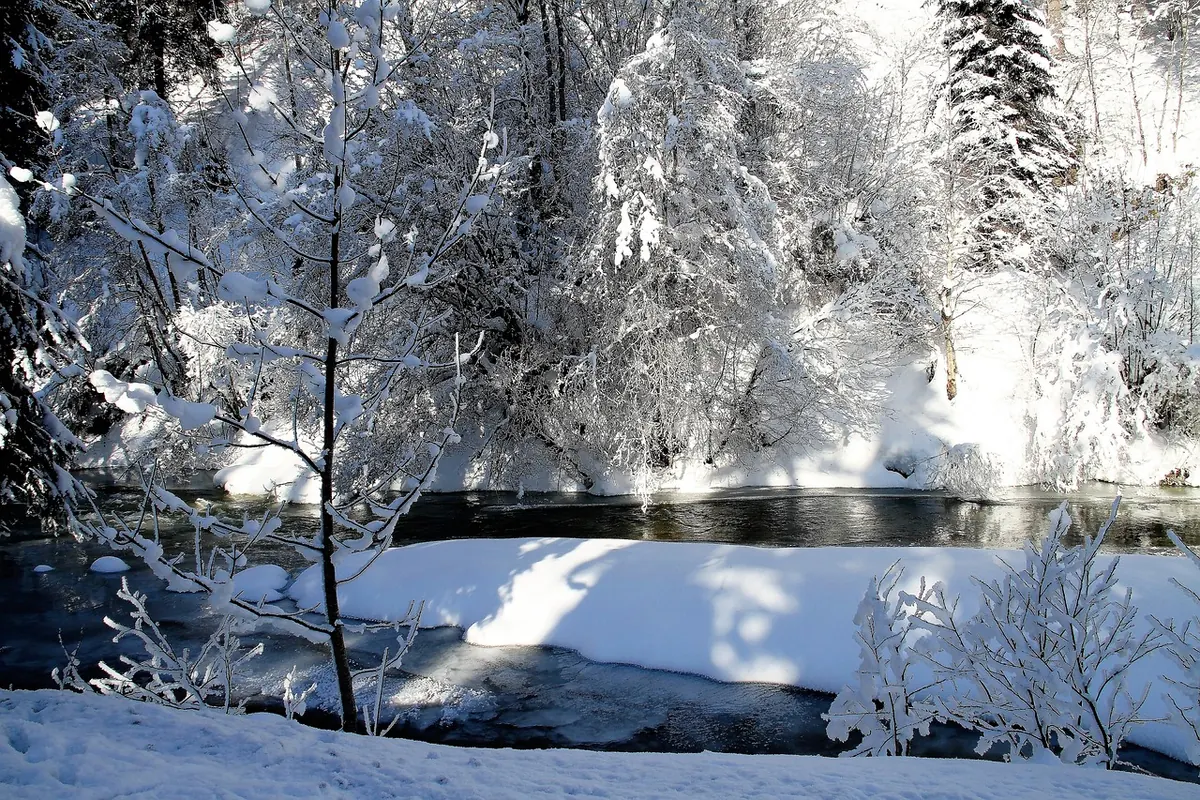
Stand at the edge of a river long enough and the surface stops looking like one continuous sheet. It separates into parts: a shallow stretch that hisses over stones, a dark bowl where almost nothing seems to move, a smooth conveyor running between them. Those parts have names, and knowing them changes a walk. You start to see where the current is fastest, where a fish would hold on a hot afternoon, where the bank is quietly losing ground. No gear required. Boots, a slow pace, and the habit of looking upstream will do.
The Three Working Parts of a River
Nearly every stretch of moving water sorts itself into a few repeating features. Learn these three and you can name most of what you see.
- Riffle. Shallow, broken, audible water over gravel, cobbles, or small boulders. The surface wrinkles and creases; you usually hear it before you can explain it.
- Run. A long, steady stretch with an unbroken surface, deeper than a riffle. The water is moving quickly, but the top stays smooth and glassy.
- Pool. Deep, slow, often dark water where the current drops away. The surface may show very little at all. Pools are where a river stores what it has carried.
Riffle, run, pool, riffle again. The pattern repeats downstream, and it is rarely random. The spacing tells you something about gradient, sediment, and how much energy the river has at that point.
Riffles: Where the Water Breathes
A riffle is where a river meets the air. The bed rises, the water shallows and speeds up, and the surface breaks into standing waves and pale crests that fold over themselves. That turbulence does real work: it mixes oxygen into the water, which is one reason riffles are the busiest neighborhoods in a river.
Look at what the water is crossing. Riffles form over coarse material, because fine silt and sand get swept away and carried downstream. The stones themselves stay clean, which is what stonefly and mayfly larvae need as they grip the undersides and graze. In many rivers, riffles are also where fish spawn, pressing eggs into the gaps between gravel.
Where a riffle runs close to a bank, expect erosion. You will often find raw, steep soil there, roots exposed, small fans of slumped earth at the waterline. That is not damage so much as the river working hardest at its fastest point.
Pools: The River's Quiet Rooms
If a riffle is noise and light, a pool is quiet and dark. Pools form where the current slows and the river scours a hollow: around the outside of a bend, below a boulder or a fallen tree, beneath a ledge of bedrock. Watch the surface and you may see boils, rounded swells that rise, spread, and vanish, showing where fast water dives and comes back up.
Depth is the defining feature, and depth explains the habitat. In summer low flows, a deep pool can be the coolest water for a long way in either direction, a refuge for fish and for the insects and amphibians they feed on. In winter, that same pool may stay open when the riffles above and below are rimmed with ice. Pools also collect what the river carries: fine sediment, leaves, sunken wood, the occasional boot. To guess how deep one runs, read the color. The darker and more uniform the surface, the deeper it usually is.
The tail of a pool, where it shallows and accelerates into the next riffle, is worth a long look. That transition is a seam, and fish often hold just below it, facing upstream, letting the current deliver food.
Runs, Glides, and Eddies
A run is the connective tissue of a river, the smooth fast water that links one feature to the next. Because the surface is unbroken, it looks calmer than a riffle, and people wading sometimes misjudge it. The current underneath can be strong and pushy. Runs make excellent places to study drift: drop a leaf in and watch how it travels, faster in the middle, slower near the stones.
You will also meet a glide, a slow, smooth, often slightly deeper stretch that sits between a pool and the water below it. The surface barely moves, but the water does; glides are where suspended silt settles out and where you can sometimes see the riverbed through a few feet of clear water.
Then there are eddies, the reverse currents that curl behind boulders, bridge piers, and log jams. Foam gathers in them and spins in place. So do leaves. Eddies are low-energy pockets, so they drop their load of fine sediment and organic matter, creating small slackwater shelves that insects and juvenile fish use as nursery space.
Reading the Banks: Cutbanks, Point Bars, and Undercuts
The water tells half the story; the banks tell the rest. On the outside of a bend, where the current swings wide and fast, look for a cutbank: steep, raw, sometimes hollowed out at the base, with soil and roots exposed. This is where the river is taking land away.
Directly across, on the inside of the same bend, the current is slower and drops what it carries. That is a point bar, a gentle gravel or sand slope, often colonized by willows and alders that stabilize it over time. Cut on one side, build on the other. Once you notice that pairing, meanders stop looking like decoration and start looking like a mechanism.
Do not overlook undercut banks, especially where roots hang over dark water. They are hard to see and important as cover, and they are also the reason to walk edges carefully rather than stepping confidently onto an overhanging lip of soil.
What the Pattern Tells You
Put the pieces together and the river starts answering questions.
- Gradient. A stretch crowded with riffles means a steeper drop or a rougher bed. Long, lazy runs and wide bends suggest a gentler valley floor.
- Erosion and deposition. Outside bends cut, inside bends build, and the evidence is under your feet.
- Habitat. Riffles produce food and spawning gravel, pools provide refuge and depth, runs serve as travel lanes and feeding lines. A healthy river has all three within a short walk.
- Recent high water. Debris caught in branches, a faint line of dried grass and silt on a trunk, stained rocks above the present surface: these mark where the river stood when it was larger.
- Change over time. After a flood, a riffle may shift a few metres, a pool may fill with gravel, a new log jam may create fresh scour. Rivers are not exhibits; they are processes.
Walking a River: A Practical Method
You can learn more in an hour of deliberate looking than in a season of strolling past.
- Walk the bank first, not the water. Cover a couple of hundred metres and simply name what you pass: riffle, run, pool, riffle.
- Stop at one riffle and follow its water with your eyes until you lose it. Where does it go? Usually into a run, then a pool at the next bend.
- Stand still for two full minutes. Boils, seams, and the direction of drifting foam appear only when you stop moving.
- Drop a twig into the current and track it. The fastest thread is the thalweg, the deepest part of the channel, and it usually hugs the outside of a bend.
- Look for the high-water marks on trees and rocks, then imagine the river a metre higher than it is now.
- Come back at a different flow. The same bend in spring and late summer can look like two different rivers.
A word on safety: moving water is stronger than it looks, and cold water drains strength fast. Check the forecast upstream as well as locally, avoid wading above your knees in fast current, and stay off undercut banks and slick algae-covered rocks. If the river is high or you are alone, read it from the shore. That is not a lesser experience.
The reward for all this looking is a quieter kind of attention. A river stops being scenery and becomes a sentence you can follow, feature by feature, all the way downstream.
Photo: sasint / Pixabay