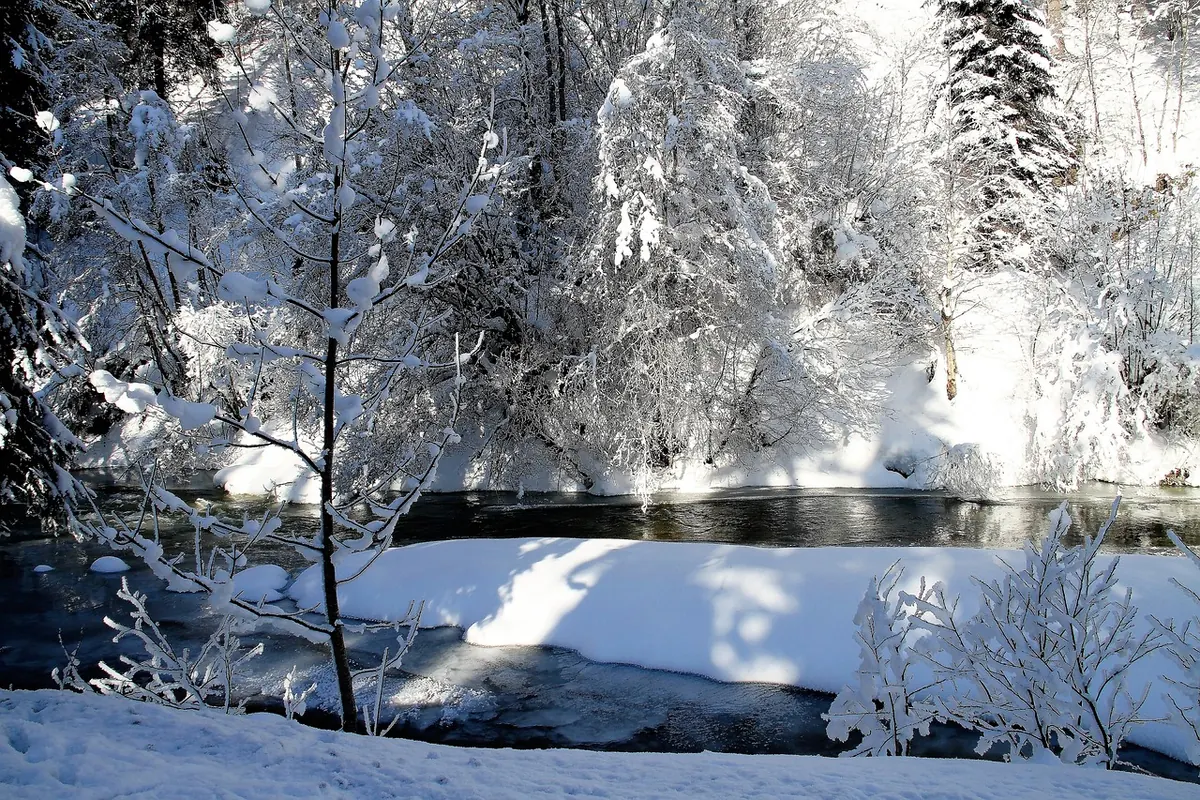
Stand at the edge of a small flowing channel and try to name it. The water is clear, ankle deep, maybe eight feet across, moving over gravel with a sound like static. Is that a brook? A creek? A stream?
Ask three people and you may get three answers, all defensible. The vocabulary of moving water is old, regional, and stubbornly unscientific. No committee ever drew a hard line between a brook and a creek, because the people using those words were describing what they saw in their own valley, not classifying watersheds for a textbook. Understanding why the terms overlap makes it easier to pick one without second-guessing yourself.
Stream Is the Category, Not a Size
Start with the word that covers everything. In hydrology and in most careful writing, a stream is any water flowing in a channel under the pull of gravity. That includes the seep you can straddle and the Mississippi. A river is a stream. A brook is a stream. A creek is a stream.
Scientists who need precision use stream order, a simple ranking system: the smallest unbranched headwater channels are first order, two first-order channels joining make a second-order channel, and so on downstream. That system tells you something useful about position in a watershed, but it says nothing about what to call the water in conversation. "Stream" carries no size claim at all. Any size judgment comes from the words you attach to it.
The Loose Size Ladder
In everyday American usage, brook sits at the small end. A brook is usually something you can step across without thinking about it — narrow, shallow, close to its source, often tucked into woods or pasture. A creek is generally the next size up: wide enough that you wade rather than step, sometimes deep enough to swim a short stretch, frequently the kind of channel a footpath follows for a mile.
Above that, people reach for "river." There is no agreed threshold. A thirty-foot-wide channel gets called a creek in one county and a river in the next, and both sets of residents will defend their word. Width alone won't settle it, because width changes with the season and with how much of the watershed has been paved or ditched.
Flow and Temperament Matter More Than Width
If you want to describe a waterway well, watch how it behaves.
Brooks are frequently spring-fed. Groundwater keeps them cold in July and unfrozen in places through winter, which is why they tend to run clear and steady, with gravel beds and small riffles. Creeks more often collect surface runoff from a broader area. They rise after rain, carry silt, and shrink in dry spells. Some of them stop flowing altogether in late summer and reappear as a chain of pools.
Those habits have names worth knowing. A perennial stream flows year-round. An intermittent one flows seasonally, when the water table is high enough. An ephemeral channel only carries water during and just after storms; the rest of the year it's a dry bed of cobbles and cottonwood leaves.
A stream is not a size. It's a category, and everything smaller than a river fits inside it.
Region Rewrites the Rules
Local vocabulary is where the subject gets genuinely interesting. The same feature changes names as you travel, often for reasons buried in settlement history, language, and terrain.
- Brook — New England, the Mid-Atlantic, and much of southern England. In northern England the same thing is a beck; in Scotland, a burn.
- Run — common in the Mid-Atlantic and Ohio Valley, as in the many waterways named Bull Run or Stony Run.
- Kill — parts of New York and New Jersey, from old Dutch influence. Catskill, Fishkill, Schuylkill.
- Branch — frequent in the American South for a modest tributary.
- Fork and prong — Appalachian and Ozark usage, usually for a split in a drainage.
- Bayou — the Gulf South: slow, often tidal, tea-colored, fringed with cypress.
- Arroyo or wash — the Southwest, for dry channels that flood hard and fast after desert rain.
- Coulee — the northern Plains and Columbia Plateau, for a steep-sided dry or seasonal draw.
Two outliers are worth remembering. In Australia, creek is used generously, sometimes for channels that would be called rivers elsewhere. And in parts of England, a creek can mean a tidal inlet off a larger estuary rather than a freshwater channel at all. Meanwhile, plenty of people in rural North America say "crick," which is not an error — it's just how the word lived in their grandparents' mouths.
What the Map Says
Place names are recorded on topographic maps and in the federal geographic names database, and they are wonderfully inconsistent. A map will label a fifteen-foot-wide channel "Stony Brook" because that's what a surveyor heard from a farmer in 1890, and the name stuck. Nearby, an equally small channel is "Mill Creek." Neither is wrong.
When you're writing about a specific waterway, the local name wins. Use it, capitalize it, and let the readers who know the place recognize it immediately. If you need to convey scale, do it with description rather than a label: "a spring-fed brook barely wide enough to step over" tells a reader far more than the word alone.
Reading the Water in Front of You
If you're standing at a channel and want to describe it accurately, work through these in order:
- Try to cross it. Step across, wade, or turn back? That single test sorts brook from creek faster than any definition.
- Look at the bed. Gravel and cobble suggest steady flow and spring influence. Sand and silt suggest a slower, lower-gradient channel.
- Read the banks. A line of matted grass, stranded debris, or undercut roots tells you how high the water gets after a storm.
- Trace the tributaries. A channel fed by several smaller ones carries more water than its own width suggests.
- Check the map and the local name. Then decide whether to use it or describe the waterway in plain terms.
- Add a modifier. "A cold, spring-fed brook" or "a wide, silty creek" beats a bare noun every time.
What to Call It
When you need a safe default, use stream. It's accurate for everything from a headwater trickle to a major river, and it never sounds wrong. Then qualify it: small, spring-fed, tidal, intermittent, fast, murky. The adjectives do the work the noun can't.
If you're writing about a particular place, follow the locals. They've been calling it something for a hundred years, and their word carries the history of the watershed with it.
One last practical note: small waterways deserve more caution than their size suggests. A knee-deep creek can rise to a dangerous torrent within an hour of rain falling miles upstream, and low-head dams create recirculating currents that are difficult to escape. Check the weather across the whole drainage, not just overhead, and stay out of fast, muddy water. The naming can wait.
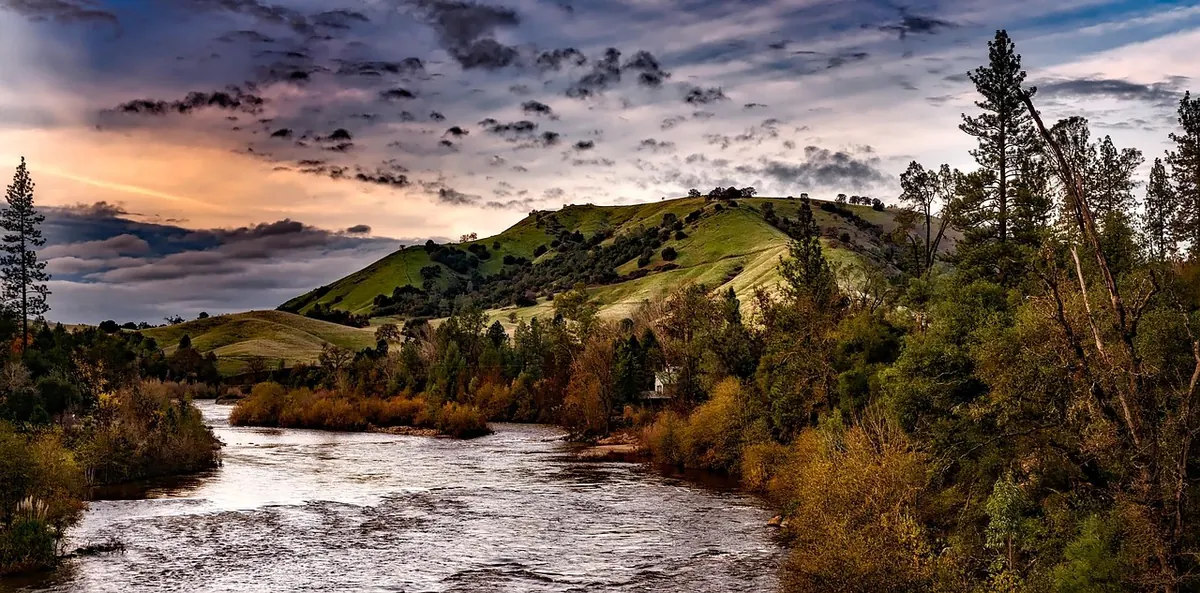
Photo: 12019 / Pixabay